applied manufacturing SYSTEMS
built on production. not THEORY.
Most manufacturing performance problems are system problems.
Applied Manufacturing Systems helps fabrication, prefab, industrialized construction, and manufacturing organizations improve throughput, production flow, manufacturing readiness, and operational scalability.
The focus is on how facility layout, material flow, equipment, automation, engineering workflows, planning, and production execution work together as a manufacturing system.
When those areas are disconnected, production becomes harder to manage, harder to scale, and harder to improve.
When they are aligned, operations become more stable, capacity becomes easier to understand, and improvement priorities become clearer.
industries Served
Applied Manufacturing Systems primarily supports:
→ MEP Prefabrication
→ HVAC Fabrication
→ Sheet Metal Fabrication
→ Industrialized Construction
→ Engineer-to-Order Manufacturing
→ Project-Based Manufacturing
→ Machinery Manufacturing
→ High-Mix Manufacturing
→ Job Shops
→ Custom Fabrication Operations
15+ Years Building & Operating Production Systems
Applied Manufacturing Systems is built from direct experience inside fabrication, prefab, and manufacturing operations.
Hands-on experience includes:
→ Sheet metal fabrication operations
→ HVAC and MEP prefabrication
→ High-mix manufacturing environments
→ Facility expansion and operational growth
→ Equipment and automation implementation
→ Digital-to-production workflow integration
→ Production execution and operational leadership
This background provides a practical view of how decisions made in engineering, purchasing, planning, fabrication, equipment, material flow, and installation affect throughput, labor efficiency, and operational stability.
What We Help Improve
Applied Manufacturing Systems helps identify the constraints, disconnects, and improvement opportunities affecting:
→ Throughput
→ Production flow
→ Material movement
→ Facility layout
→ Equipment utilization
→ Automation readiness
→ Manufacturing readiness
→ Engineering-to-production coordination
→ Capacity planning
→ Operational scalability
The goal is not to optimize one isolated area.
The goal is to improve how the manufacturing system performs as a whole.
Manufacturing Performance
Is A System
Production performance is influenced by more than equipment alone.
Facility layout, material movement, equipment decisions, engineering workflows, planning processes, purchasing, and production execution all affect manufacturing performance.
A new machine will not fix poor flow.
Automation will not solve unstable releases.
Software will not remove bottlenecks created by disconnected workflows.
Applied Manufacturing Systems focuses on how those areas interact and where the operation is being constrained.
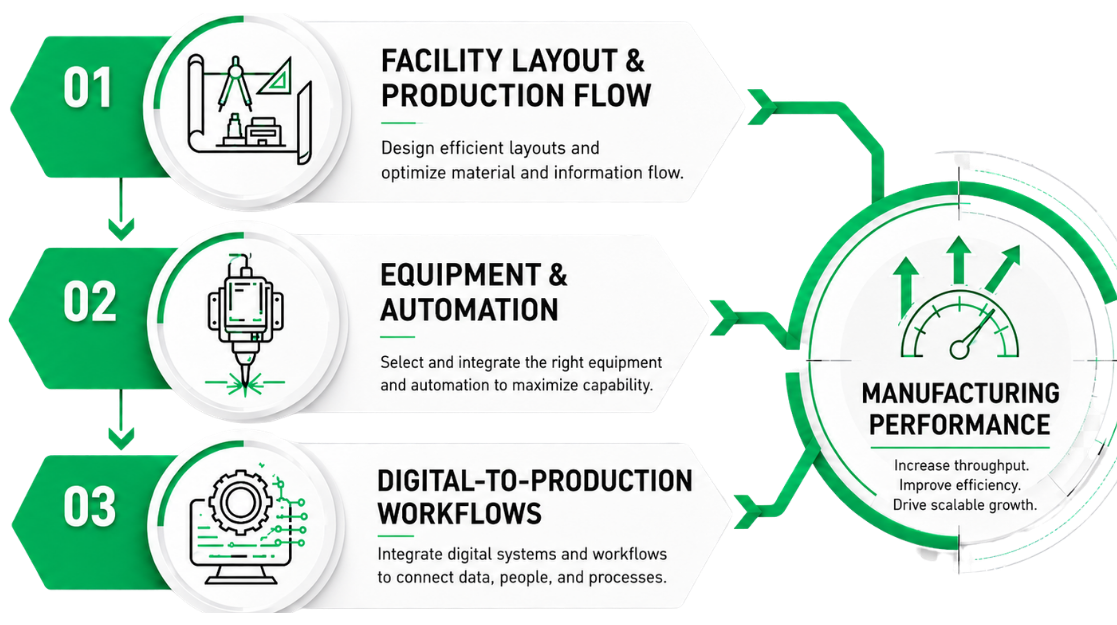
Where Problems Usually Start
Facility Layout & PRODUCTION Flow
→ Material moves farther than necessary
→ Work-in-process accumulates between departments
→ Bottlenecks limit throughput
→ Equipment placement no longer supports flow
→ Expansion occurs before flow is understood
→ Facility constraints make growth harder
Equipment & Automation Strategy
→ Equipment is selected without full system evaluation
→ Automation is expected to solve workflow problems
→ Capacity is not balanced across departments
→ Labor savings do not materialize
→ New equipment creates downstream constraints
→ Capital decisions are made before readiness is clear
Digital-to-Production Integration
→ Engineering and production are disconnected
→ BIM releases do not align with fabrication requirements
→ CAD/CAM workflows create downstream friction
→ ERP, routing, and planning do not match how work moves
→ Production teams compensate for missing information
→ Manufacturing readiness issues disrupt execution
Core Advisory Services
Manufacturing Systems Assessment
Identify constraints, bottlenecks, workflow disconnects, and improvement priorities across the operation.
This is often the best starting point for organizations trying to understand what is limiting throughput, production flow, capacity, or scalability.
Facility Layout & Production Flow
Evaluate how material, work, equipment, people, and information move through the facility.
Focused on reducing unnecessary movement, improving flow, identifying layout constraints, and supporting future growth.
Equipment & Automation Strategy
Support better equipment, automation, capacity, and capital investment decisions.
Focused on equipment utilization, automation readiness, labor requirements, workflow integration, and long-term production needs.
Digital-to-Production Integration
Improve how engineering, BIM, CAD/CAM, ERP, routing, planning, and production workflows support manufacturing execution.
Focused on release structure, manufacturing readiness, information flow, and office-to-floor coordination.
Fractional Manufacturing Advisory
Provide ongoing manufacturing systems guidance without adding full-time operational leadership.
Focused on helping leadership evaluate operational issues, prioritize improvements, and make better decisions around production flow, equipment, layout, systems, and scalability.
How We Work With Clients
01
Understand The
Current Operation
Review how the operation works today, including production flow, material movement, equipment utilization, information flow, and operational constraints.
02
Evaluate System Performance
Assess how layout, equipment, automation, engineering workflows, planning, and production execution interact.
03
Identify Constraints
& Opportunities
Determine what is limiting throughput, creating friction, increasing labor dependency, or restricting growth.
04
DEFINE PRACITAL IMPROVEMENTS
Develop recommendations based on operational realities, production requirements, implementation effort, and long-term scalability.
Why Applied
Manufacturing Systems
15+ Years Direct Experience
Built, operated, scaled, optimized, and relocated fabrication, manufacturing, and MEP prefab environments from concept through full-scale production.
Systems-Level Perspective
Evaluate production performance across layout, equipment, automation, material flow, engineering workflows, planning, and execution — not isolated components.
Capital-Aware
Decision Making
Equipment and automation recommendations are tied to production requirements, utilization, labor realities, workflow readiness, implementation risk, and return on investment.
Execution-Focused Recommendations
Practical recommendations designed around real production environments, not generic improvement programs.
Discuss Your Operation
Whether you are planning expansion, evaluating equipment investments, improving production flow, or working through recurring operational challenges, most conversations start in the same place:
Understanding how the manufacturing system functions today.
No obligation. No sales pitch.
Just a focused discussion around your operation, challenges, and objectives.